Climate change is a global crisis that undermines human safety, livelihoods, food security, and sustainable housing. In Freetown's informal settlements, the frequency and severity of climate change hazards and vulnerabilities such as flooding, mudslides, building collapse and fire incidents mirror the widening social inequalities faced by residents (See table 1). This is exacerbated by Infrastructure challenges including poor solid waste management and drainage systems, which increases residents' exposures to risks of waterborne diseases (through contaminated underground water), injuries and loss of lives during extreme weather events. Climate related disasters also limit livelihood options, deepen poverty and weaken the capacity to plan and respond to future shocks. In this blog, we explore informal settlements' understanding of climate change, and their coping strategies. This blog has been informed by our engagement with residents of three informal settlements in Freetown (Cockle Bay, Colbot and Moyiba), using narrative inquiry methods. Our goal is to amplify the voices of informal settlement residents by conveying their challenges and response to climate change, health system and related urban stakeholders to enhance an inclusive climate change response.
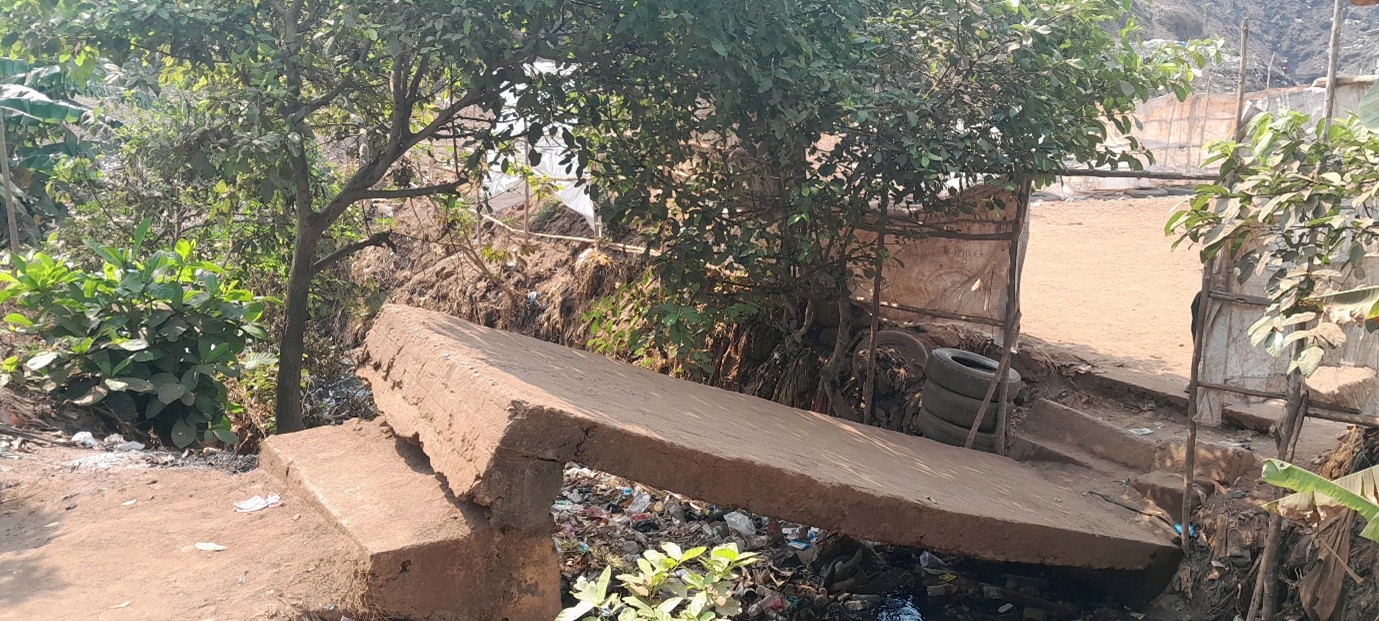
A collapsed foot bridge linked to flooding
Located along the Aberdeen Creek built mainly on reclaimed lands from mangroves and tidal flats. The settlement is densely occupied by informal housing structures. It is located approximately 5.2 km from the city center with an estimated population of 20,000. Residents rely on fishing, small-scale trading, and daily wage labour. Despite recurrent flooding and tidal surges, the settlement continues to expand along the waterfront.
Coastal flooding from sea-level rise; Heat; High tides; Fire incident; Air pollution; Storms
Coastal community located in eastern Freetown near the Bomeh dumpsite. The community has a population of approximately 12,000 and is located 3.5 km from the city center. Built along swampy lowlands, the community is exposed to severe environmental and health hazards. Livelihoods include informal trade, fishing, scavenging, and wage labour. Seasonal flooding frequently disrupts homes and alleyways, leading to displacement and property loss.
Flooding; Rockfalls; Heat; Air pollution from waste burning; Fire incidents; High tides and storm surges; building collapse
Hillside community in eastern Freetown. The settlement has an estimated population of 18,000 and is located 4.6 km from the city center. Residents depend on stone mining, petty trading, and informal labour. Rapid population growth has driven housing expansion into unstable terrain, resulting in deforestation and increased exposure to landslides and erosion.
Flooding; Heat; Mudslides and Landslides; Air and dust pollution from stone mining; Storms and fire incidents; Rockfalls and building collapse
Climate change deepens existing social inequalities, including inadequate housing, limited access to water, sanitation and healthcare. In Freetown, inequitable access to land and housing drives housing challenges, leading to housing construction in ecologically sensitive areas, such as seafronts, hillslopes and protected mangrove sites. Informal settlements are largely built on reclaimed lands, covering about 36% of the city's land area. The Federation of Urban and Rural Poor (FEDURP) estimates that Freetown has about 70 informal settlements. As a result of limited investment in infrastructure (e.g. informal settlement upgrades), informal settlement residents are becoming increasingly exposed to climate-related hazards. The displacement of over 50,000 people from the decade long civil war (1992 -2002), and the search for better life by rural migrants also contributed to rapid urbanisation and informal settlement expansion in Freetown, where people face increased service access barriers.
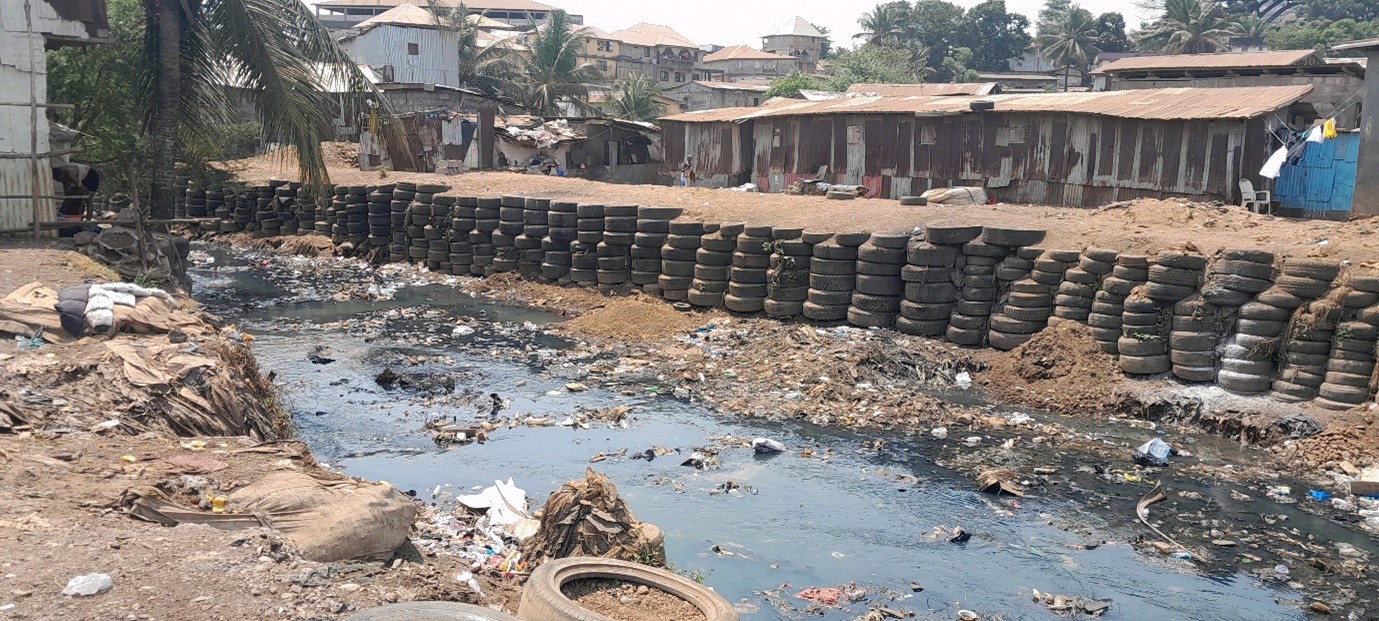
Use of old tyres for flood mitigation in Colbot
Knowledge systems are critical in shaping individual and collective responses to daily and episodic crises. Since human creation, knowledge systems have remained vital to community understanding of local challenges, and in designing specific and sustainable solutions. Local knowledge is often ingrained in social and cultural codes of practice and symbolic language which contributes to problem solving and the advancement of social cohesion. People have used these socially ingrained knowledge systems at different stages of human civilization to develop cures for ill health, construct resilient infrastructures (e.g. roads and drainages), and strengthen food security (e.g. drought-resistant crops). In informal settlements in Freetown, local knowledge has increased people's resolve to respond to climate change hazards by building on their awareness of their local environment and social networks, as described below:
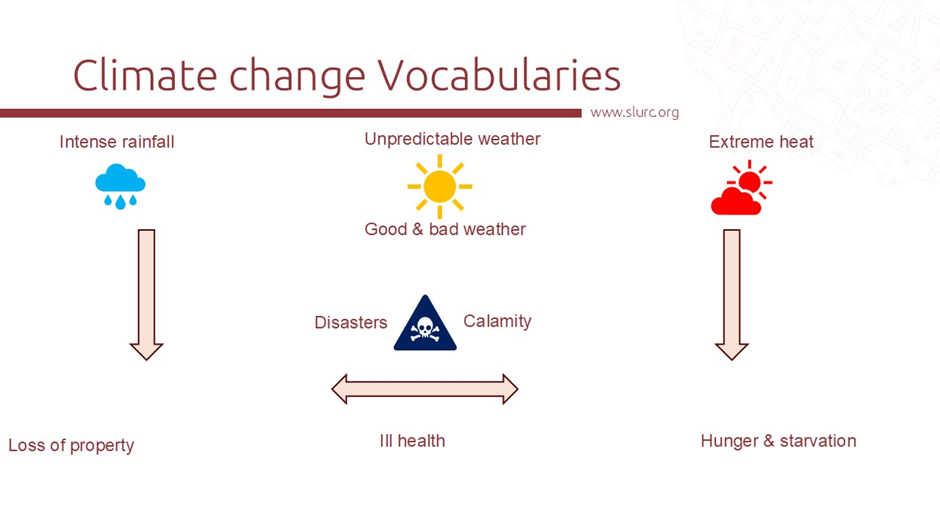
The diagram below provides a collection of vocabularies describing how residents understand, experience and cope with climate change. It was drawn from fieldnotes and transcripts reflecting these daily and episodic experiences.
Fieldwork, 2025: Climate vocabularies in Freetown
Stories from residents experiencing climate change
In their rich and symbolic languages, participants described climate change based on their individual experiences and interpretations. These explanations included frequent changes in the weather patterns such as intense rainfall, extreme heat, storms and high tides. Participants' narratives linked the changing weather patterns to hazards such as flooding, heatwaves, mudslide and building collapse. Unpredictability in the weather conditions were vivid in the explanations of residents, which included unexpected rainfall, storms and sunshine.
"It has been raining constantly for three days. The sky is dark... Later, I went to the other side of the city, and I was surprised that the sun shining brightly. I asked myself what could cause such a change..."
— Participant living with disability
Relating their interpretations of climate change, one man living with a chronic health condition referred to it as a 'fitina' which he literally translated as disaster or calamity in his local Temne dialect. While fitina is now commonly used as part of the Krio lingua franca, it is believed to have emerged from the Arabic language which is roughly interpreted as confusion, strife or trouble. Descriptions of fitina also had spiritual explanations, reflecting the notion of inevitability, or beyond human control.
"Flooding is caused by God, and I can't stop what He (God) controls"
— A female informal worker
Participants recounted their observations of persistent rising temperatures over the last five years. Across settlements, extreme heat was reported in terms of health and livelihood impacts. Informal workers engaged in outdoor labour such as stone mining, petty trading and scavenging spoke about the difficulties of coping with extreme heat, which impact their health and income. Regarding heat related health impacts, exposures to heat rash, aggravation of respiratory conditions such as asthma were often mentioned. One woman living with disability described the impact of extreme heat in terms of housing typology. She said that living in a ''Panbody'' house made of CI sheets increases heat levels:
"When the sun heats the CI sheet for the rest of the day, the heat usually becomes intense inside the house at night"
— A woman living with disability
Participants' facing diverse climate change hazards in informal settlements reflected on the overlapping vulnerabilities they face. For many, the use of the words ''stress'' and ''pain'' symbolised shocks from events such as flooding, often causing the loss of property and livelihoods, and constraining access to food. Experiences with climate change also related to the intensification of chronic diseases, such as hypertension, and increased risk of hunger and healthcare access barriers. As one man living with disability narrated, climate change impacts him in diverse ways, including the loss of property and his medication:
"Just last week, there was a heavy downpour that led to flooding... I lost most of my belongings. Even my medicines were carried away by the water."
— A man living with disability
In their rich and symbolic languages, participants described climate change based on their individual experiences and interpretations. These explanations included frequent changes in the weather patterns such as intense rainfall, extreme heat, storms and high tides. Participants' narratives linked the changing weather patterns to hazards such as flooding, heatwaves, mudslide and building collapse. Unpredictability in the weather conditions were vivid in the explanations of residents, which included unexpected rainfall, storms and sunshine.
"It has been raining constantly for three days. The sky is dark... Later, I went to the other side of the city, and I was surprised that the sun shining brightly. I asked myself what could cause such a change..."
Relating their interpretations of climate change, one man living with a chronic health condition referred to it as a 'fitina' which he literally translated as disaster or calamity in his local Temne dialect. While fitina is now commonly used as part of the Krio lingua franca, it is believed to have emerged from the Arabic language which is roughly interpreted as confusion, strife or trouble. Descriptions of fitina also had spiritual explanations, reflecting the notion of inevitability, or beyond human control.
"Flooding is caused by God, and I can't stop what He (God) controls"
Participants recounted their observations of persistent rising temperatures over the last five years. Across settlements, extreme heat was reported in terms of health and livelihood impacts. Informal workers engaged in outdoor labour such as stone mining, petty trading and scavenging spoke about the difficulties of coping with extreme heat, which impact their health and income. Regarding heat related health impacts, exposures to heat rash, aggravation of respiratory conditions such as asthma were often mentioned. One woman living with disability described the impact of extreme heat in terms of housing typology. She said that living in a ''Panbody'' house made of CI sheets increases heat levels:
"When the sun heats the CI sheet for the rest of the day, the heat usually becomes intense inside the house at night"
Participants' facing diverse climate change hazards in informal settlements reflected on the overlapping vulnerabilities they face. For many, the use of the words ''stress'' and ''pain'' symbolised shocks from events such as flooding, often causing the loss of property and livelihoods, and constraining access to food. Experiences with climate change also related to the intensification of chronic diseases, such as hypertension, and increased risk of hunger and healthcare access barriers. As one man living with disability narrated, climate change impacts him in diverse ways, including the loss of property and his medication:
"Just last week, there was a heavy downpour that led to flooding... I lost most of my belongings. Even my medicines were carried away by the water."
To conclude, understanding the local knowledge and adaptive capacities of marginalised urban residents is important in responding to climate change. Knowledge enhancement of people living in vulnerable settings on climate change will help to increase their capacity as potential first responders. It is therefore important for policy makers, healthcare providers and diverse stakeholders to recognise the ongoing efforts of marginalized urban residents and build upon these actions to enhance a coordinated response to climate change.
Knowledge systems that are rooted in social, cultural, and environmental awareness are transformative as they help individuals, households, and communities to adapt to adverse conditions. Building on exiting actions by vulnerable individuals can support policies and promote inclusive community-led risk mitigation. Finally, shared understanding of local adaptation measures can help to address ongoing maladaptation that may amplify existing risks. Therefore, the development of local capacities through shared understanding of climate risks cannot be overstated.