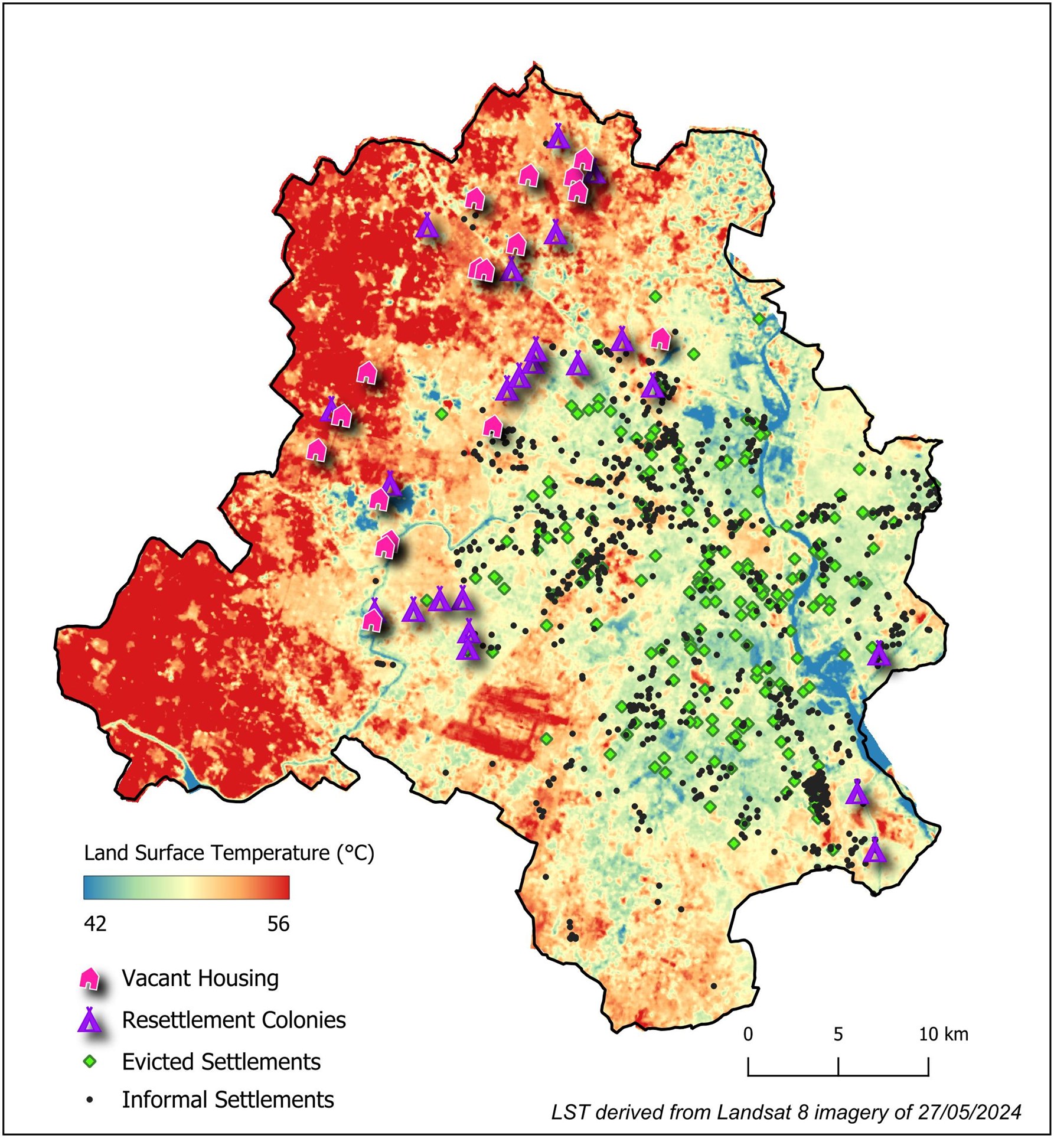
Map 1. Spatial Patterns of Land Surface Temperature, Informal Settlements, and Resettlement Areas
Source: Authors and the IIHS Geospatial Lab. Vacant housing locations shared by Social Design Collective.
If you made a map of vulnerable, informal settlements in the cities of the global south, one pattern would emerge regardless of whether you were in Delhi, Nairobi, Freetown or Cape Town. It is this: the geographies of environmental risk in the city are often those of low-income housing and informal settlements1. This isn't an absolute relationship by any means — not all informal settlements are in environmentally risky areas; and not all environmentally risky areas have vulnerable settlements in them. Yet many do and the logic behind why is quite intuitive. Informal settlements often self-build or auto-construct homes on public or private land that they do not formally own in title. For this to occur, the land they build on must first be vacant. Especially in the deeply competitive land markets of big cities in the global south, vacant land is vacant for a reason.
One of the most common of such reasons is that the land bears environmental or infrastructural risk. It lies in a low-lying area prone to floods, on slopes prone to run-offs or landslides, on the edges of water bodies, near railway tracks or highways, under high-tension power lines, or on land near waste disposal and infrastructure. It's land you wouldn't want to build on unless you had to. This means that many informal settlements, in addition to being vulnerable socially, infrastructurally and economically, are also vulnerable spatially. Many have always been sites of environmental risk, far before we started talking about climate change.
What has always made this risk worth taking was a chance to live in the city at all and, most importantly, to live near work, transport and life. Households made sharp and near impossible trade-offs between inadequate infrastructure and services, small houses and environmental risk on the one side but the nearness to work in an otherwise impossible real estate market on the other. In writing elsewhere, one of us has described this as a trade-off between adequacy, affordability and viability that defines housing injustice especially in cities of the global south2.
The presence of environmental risk has often been one of the arguments used to justify evictions and demolitions of informal settlements, as well to say that in-situ upgradation or improvement is not possible. We cannot secure your lives or housing here. Given environmental risk, the argument goes, resettlement is the only option possible. There is a vast body of work on the difficulties of resettlement across cities of the global south that shows how it breaks exactly the balance between affordability, adequacy, and viability we described earlier. In this essay, however, we want to focus on a different part of this claim. If resettlement is the only option on offer because environmental risk must be mitigated, then are resettlement sites themselves free of such exposure to hazard?
In working on heat maps in Delhi in our on-going research, we noticed something. We'll lay out the pattern we see in two maps. Map 1 below shows Land Surface Temperature in Delhi, using remote sensing data from May, 2024. The closer to yellow and red, the hotter it is. Map 2 shows what is called a Land Surface Temperature Spatial Anomaly. Put simply, it is a way to see how heat varies across the city is to compare each location's temperature to the city's average. This map shows how much hotter or cooler each spot is than the overall mean surface temperature. Areas shown in red are warmer than the city average, while blueish areas are "relatively" cooler. This helps reveal the city's internal heat pattern — showing where heat tends to build up and where cooler zones exist. Across both maps, you'll notice a heat pattern in the western side of the city, from the northwest to the southwest.
The spatial distribution of heat in urban environments is not random. It follows patterns of land use, vegetation cover, and built density. Areas with more concrete and less green cover tend to experience higher temperatures due to the urban heat island effect. This phenomenon is well-documented across cities globally, but its intersection with housing patterns reveals deeper inequities in how environmental burdens are distributed across urban populations.
Understanding these patterns requires us to look beyond simple temperature readings. We must examine how historical planning decisions, economic forces, and social inequalities have shaped the urban landscape. The maps we present here are not just technical documents—they are visual representations of systemic patterns, showing how populations are systematically exposed to environmental conditions.
As we scroll through this analysis, keep in mind that each data point represents real families, real homes, and real lives affected by these spatial patterns. The heat we measure is not abstract—it translates into health impacts, economic costs, and daily realities for those living in the hottest parts of the city.
Now let's look at housing. The black dots are existing informal settlements in the city. Many are not in the hottest areas in the city. This is a relief, quite literally. While informal settlements may have other environmental risks we described above, they are not marked by a disproportionate exposure to heat. The green dots are settlements that have been evicted from 1990 to the present, part of a violent restructuring of the city through the demolition of the homes of its working families. These too, in their original location, where in the bluer or yellower areas of the map.
Post-eviction: the geography of the green dots is changing. Many evicted got no forms of resettlement. Those that did were resettled in the resettlement colonies marked in purple. Some are to be allocated homes in vacant and publicly owned house earmarked for low-income, working families. These are marked in pink. Between pink and purple lies a significant part of formal, legal, state-built or sanctioned low-income housing in Delhi.
Here then lies an emerging concern: this new housing stock for working families – the pink and the purple – is precisely in the corridor of heat in the western part of the city marked by Map 1, and the LST Spatial Anomaly in Map 2. Put simply: resettlement and new low-income housing are both increasing exposure to heat for residents, many of whom were, ironically, told they were exposed to hazard and risk in their original locations which is why they must be moved. From blue and yellow, working families are being peripheralized to orange and red.
Many have written against the brutality of forced evictions, marked them as deep violations of fundamental and human rights, and condemned peripheral resettlement to the corners of the city not just in Delhi but across cities of the global south3. The main focus of much of that work – correctly – is that distance makes livelihoods impossible for residents as well as excludes them from networks, services and infrastructure. In one text written by one of the authors of this essay, it was described as being "swept off the map4". Today, we point out something different: that new forms of environmental risk are being created through not auto-construction and self-built housing but state-mandated resettlement and new low-income housing construction.
This pattern reveals a troubling irony in urban planning and resettlement policy. While the stated justification for evictions often centers on protecting residents from environmental hazards, the actual outcome frequently exposes them to new and potentially more severe risks. The western corridor of Delhi, where much of the resettlement housing is concentrated, experiences significantly higher temperatures than the areas from which residents were displaced.
The implications of this spatial reorganization extend beyond immediate discomfort. Higher temperatures correlate with increased health risks, particularly for populations including children, elderly residents, and those with pre-existing health conditions. The economic impacts are also substantial—higher cooling costs, reduced productivity during extreme heat events, and increased healthcare expenses all burden families who are already economically marginalized.
What makes this situation particularly concerning is that it represents a form of state-created exposure. Unlike the environmental risks that residents knowingly accepted in their original settlements in exchange for proximity to livelihoods, these new heat exposures are imposed through policy decisions. Residents have little agency in this process and limited resources to adapt to their new environmental conditions.
The spatial analysis presented in Map 2 makes this pattern unmistakable. The concentration of resettlement colonies and vacant low-income housing in the city's hottest zones is not coincidental—it reflects broader patterns of how land is valued, allocated, and developed in rapidly growing cities. The least desirable land, from a climate perspective, becomes the site for housing the city's most economically constrained populations.
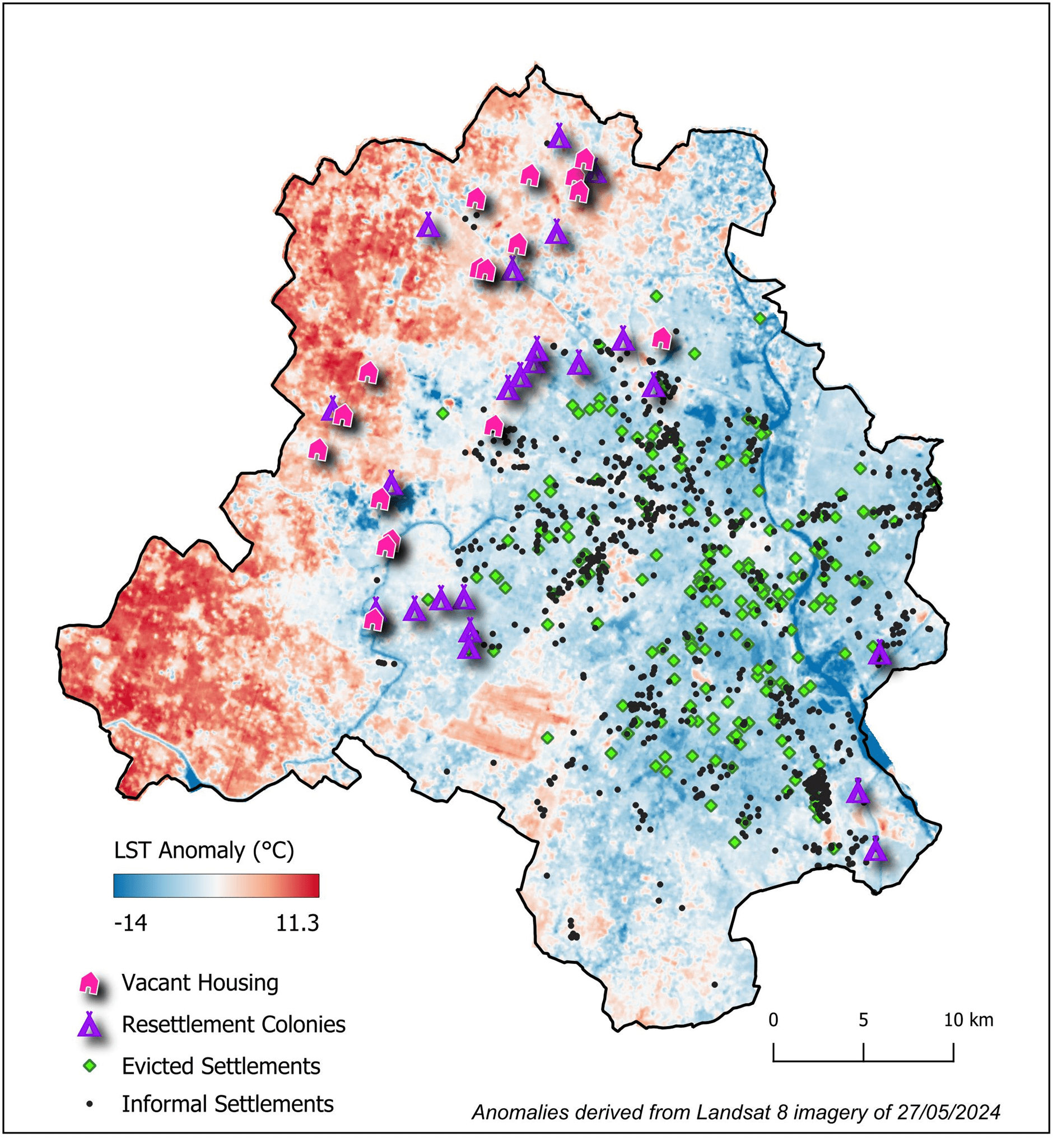
Map 2 Land Surface Temperature (LST) Deviations from the City-Wide Mean
Source: Authors and the IIHS Geospatial Lab. Vacant housing locations shared by Social Design Collective.
The most affected of city's residents have been displaced not only to the city's economic peripheries but also to its most rapidly heating landscapes – its ecological peripheries. The geography of resettlement is almost entirely red, as is the geography of much of the current vacant low-income housing stock. The more urban restructuring moves the remaining informal settlements that are still in the yellow and green to the deep reds of the periphery, without any ameliorative adaptation or mitigation measures, the more new environmental risks are being created for those that already hold multiple challenges. The more new low-income housing stock does not take into account emergent ecological and environmental risks, the more it will reproduce older patterns while adding to rather than mitigating new forms of risk. These are not the same risks that households knew they were taking on as a price of being in the city. These are risks imposed on them by state action, by eviction and resettlement, by patterns that do not consider new climactic risks that all cities must now face.
1. One of the first to make this argument academically was David Satthertwaite. See, among others in his rich body of work, Hardoy, J. E., & Satterthwaite, D. (2014). Squatter citizen: life in the urban third world. Routledge.
2. See Bhan (2018) Housing, Common Sense, and Urban Policy in India, in Burte and Bhide (eds) Urban Parallax. Yoda Press: New Delhi.
3. See Bhan, G. (2016). In the public's interest: Evictions, citizenship, and inequality in contemporary Delhi (Vol. 30). University of Georgia Press.
4. See Menon-Sen, K., & Bhan, G. (2008). Swept off the map: surviving eviction and resettlement in Delhi. Yoda Press.