
Driving into Langa today, left off the N2 onto Bhunga Avenue, right off Bhunga Avenue onto Rhodes Street (his essence persists), and you get to the 'New Flats'. This is where Nontobeko and Nozibele have lived since they moved to Cape Town, and where their children were born. Worsening weather conditions exacerbate the precarity built into the walls and history of their homes.
Reception Depot, Hostel, Upgrade: Introducing the New Flats
Where they live today were originally the township's 'temporary reception depots': used from the 1930s to control the movement of Black men in and out of the township and city. 'Newcomers' to Langa had to stay in the depots, in quarantine and awaiting allocation as cheap labour, primarily at the docks.
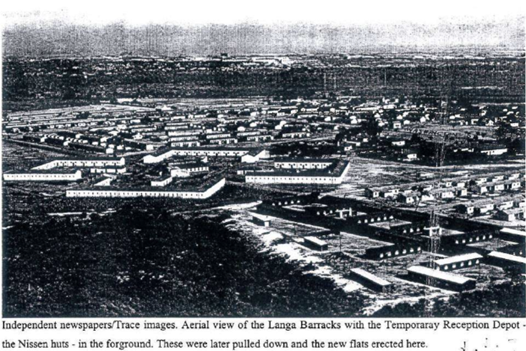
Photo Source: City of Cape Town Interdepartmental Workshop Report, November 2013.
In the 1970s, the depots were converted to double-storey hostels, dubbed the 'New Flats'. The hostels were not designed to sustain life, but to maximise and extract work from the residents during their brief permitted stay in the City. Women were not allowed to live with their partners in the flats, and raising a family was made impossible, with overcrowded rooms and shared bathrooms.
This is where Nozibele and Nontobeko's fathers lived as migrant labourers, and later, at the advent of South African democracy in 1994, this is where both women joined their fathers as young schoolgirls moving from the Eastern Cape.
As the poorly built hostels decayed around them, the two women made lives for themselves in Langa, sharing single rooms with multiple families.
25 years later, in 2019, they were allocated rooms in 'upgraded' sections of the New Flats. Many of these apartments are still shared, with one family per room.
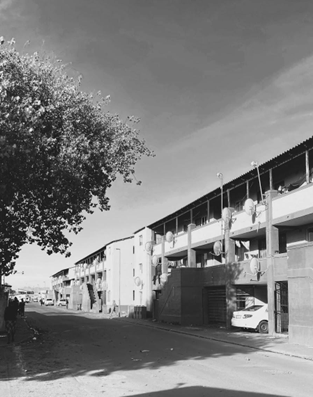
New Flats, corner of Mosheshe Avenue and Rhodes Street. Photo: own, June 2025.
New home, new hazards, same kak
It was a sunny day, following a week of heavy rain, when I first met Nontobeko. She lives on the second floor of one of the westernmost buildings of the New Flats. She offered for us to chat in the 1m x 1m communal kitchen.
Nontobeko remembers the soggy winters when she first moved to Langa. Back in her father's shared room, "when it's winter time, you will see from the walls. The walls will be mouldy." There is still mould in her upgraded flat, which she thinks is more affected by rain than the old hostel. Mould is associated with chronic respiratory diseases, and Nontobeko reports that tuberculosis (TB) is one of the most prevalent illnesses in the community.
When it rains, water pools in the street below her room. After many days of rain, the water gets too high to walk without getting soaked. Often, her son can't leave the house to go to school, and she has to send his teacher photographs of the flooded street, a sick note from the township.
The kind of flooding that prevents her from leaving home is not something Nontobeko used to experience in the past.
She believes that many people fall sick in her area due to the stench of the standing water. "It's dirty and it stinks and you can't even open the window because it stinks." Her neighbour spends his days outside on the stairwell, and she says it's because he inhales this dirty air that he has TB.
Nontobeko's upgraded room, which she is meant to pay rent for but can't afford, was the outcome of a municipal upgrading initiative. In a similar spirit to "Hostels to Homes" projects, it was intended to deliver dignified, liveable homes and halt the legacy of apartheid architecture. Yet it is since living in this upgraded project that Nontobeko's conditions have worsened.
While it's difficult to control for climate change, in a situation so layered with vulnerability, Nontobeko has noticed worsening weather conditions, particularly over the last two years. "Since last year, I'm saying, 'no man! It's happening a lot now.' Normally, it wasn't like this before." This winter was the first time that she chose not to work, for months at a time, because of the weather. She sells socks at an informal stand at the taxi rank, but the long distance to work in the rain, and standing outside in the freezing cold, was not worth the R60 (if she's lucky) that she may earn in a day. Getting sick would mean more money lost on transport to the clinic.
Nontobeko lives on the second floor, and so the ponding water, "amanzi ayacwala", does not seep under her doors like it does on the ground floor. Recently, her neighbours below have had to build cement barriers at their entrances to stop the water from flowing inside.
It's not only the floor you live on, but the side of the street that determines your exposure to intense rainfall and waterlogging. Nozibele lives in the building across the road from Nontobeko.
Despite being on the ground floor, she isn't too affected by waterlogging as the water flows to the other side of the road."I think this land is sloping…the water runs through to them and into the house. All the people on that side are always affected. I think they receive water from our flats and the rain, it runs."
But, like Nontobeko, Nozibele noticed a change in the weather and a more perilous rainy season when the households opposite her had to build cement barriers for the first time.
Nozibele described similar expounding factors and impacts of the sitting water: because the New Flats are so dense, the drains get blocked easily. And when the drains are blocked, the water sits and smells. "You see, the children even get sick. We got sick. Because the air is polluted now, we're breathing air that's polluted." Later, she attributed high rates of diarrhoea in the settlement to the blocked drains and dirty air.
Pointing across the road to the upgraded blocks most affected by flooding, Nozibele is bitter. "They didn't start afresh; they just changed here and there. They didn't start rebuilding it as new. It's still that old place our daddies were staying here, they just renovated it and painted.
We think even the pipes, they're old pipes of the 1970s. They didnt even change the pipes." Crumbling infrastructure and deficient services reflect a century-old policy of neglect in Cape Town's Black neighbourhoods.
From this enduring context, Nozibele revealed small coping tactics that have become features of everyday life. Residents across the road have relied on people in her block to assist during the rainy period when the road is a puddle:
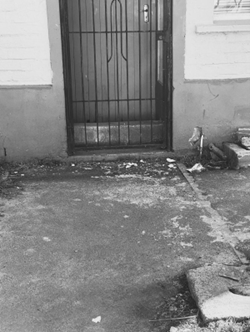
A cement wall to stop ponding water from getting inside. Photo: own, August 2025.
Where their current living situation is the official solution to undignified housing, Nontobeko and Nozibele's stories underscore the growing risks facing vulnerable urban settlements as weather hazards intensify. Their stories warn of the unequal burden of climate change borne by those relegated to Cape Town's peripheries; this, even in areas considered 'adequate housing', let alone informal settlements in Langa.
The state has delivered the upgraded house, the ward councillor still has to consult, and so life in the New Flats feels the same as for their fathers, now with a gumboot wade and cement-barrier-hop upon returning home.