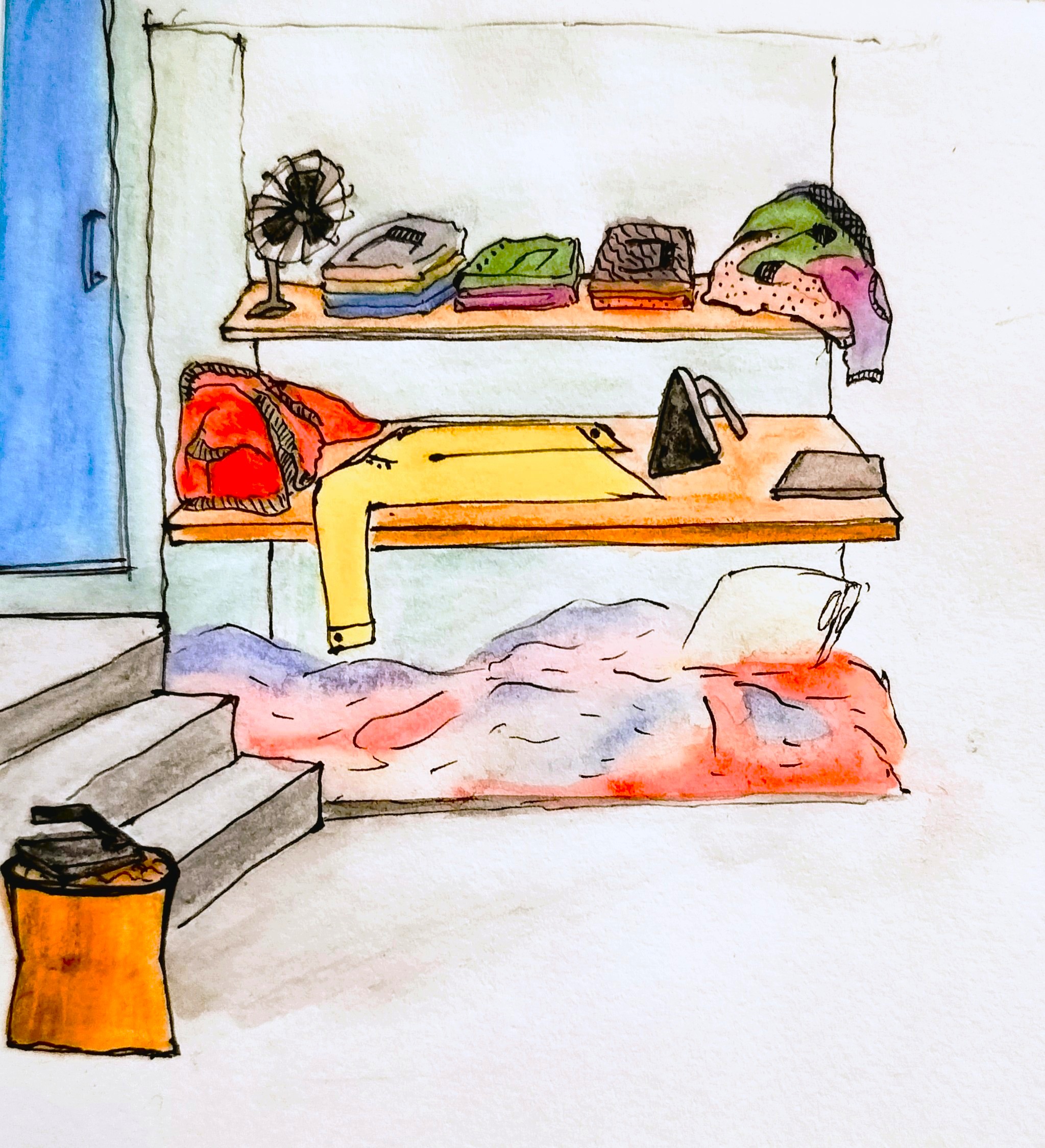
Sm is a 60ish year-old woman, who lives in a single storey house in Nehru Nagar with her husband and son. The family irons clothes for a living, using traditional metal irons that are heated on stoves of hot coal. It is a hot day in April, and she is ironing clothes. There is a small fan in a corner, and she is asked if that fan is enough for her. 'No, I turn off the fan and work. The clothes fly if the fan is on'. How do you manage then? 'Body gets drenched in sweat, I cannot tolerate it. It is completely drenched… I cannot tolerate it. I keep sitting and ironing the clothes, I cannot tolerate it.' A little later she is asked: what do you do to keep yourself cool? 'We live like this only. If one feels hot, and there is no electricity, I sit outdoors. What else will one do.'
On a June morning, we are talking to her again and ask what it was like when she first moved to Nehru Nagar on getting married, which was 40-45 years ago. 'It was all jungle, was garden. There were trees all around here. All of it has been cut down and then these apartments were made.' At some point she talks about the material evolution of her house and also remarks that her house runs hot 'because it is a single storey, there is nothing upstairs (to insulate it)'. Later, we ask about heat and about her work, and she talks about sweating and feeling 'absolutely restless'. She says 'because of the heat, we don't light the stove (to heat coal for ironing clothes) these days. No, it is very hot. I am unable to (iron clothes) anymore now. Food also – I cook it somehow or another.'
There are several different things at play here, which interact with each other. Surely, the microclimate in the vicinity of her house has altered over the last 45 years with trees cut down to build multi-storeyed apartment buildings creating an urban heat island. An altered microclimate renders sitting outdoors less effective as a coping practice against heat. It is also clear that Sm makes trade-offs between her body, health and livelihood, and there is something of a nonchalance and resignation in it. By June the heat is bad enough for her to stop ironing clothes, with effects on livelihood and income. The heat also hinders unpaid carework needed for everyday sustenance – like cooking food. While one sees clearly that heat bothers her, its causal relation to climate change (CC) is not directly evident. What then is critical in the story we are seeing emerge? Let me explain.
Different forms of CC may be categorised into rapid-onset and slow-onset based on temporality and clarity in their beginning and end. Rapid-onset climate change events like floods, cyclones, heatwaves, landslides, etc. are compressed over a short duration – hours, days, sometimes weeks. Take note: the impact of rapid-onset events may last longer, but the event itself is condensed in this short time frame. On the other hand, slow-onset climate change processes like increasing mean temperatures, changing precipitation patterns, sea level rise, desertification, biodiversity loss, ocean acidification etc. take place over a long period of time – years, decades, even centuries. While there is no formal definition for slow-onset, nor an exhaustive list of phenomena that fall under this category, there is scholarship around the differences in these two categories, how they act differently and how slow-onset climate change receives considerably lesser attention than rapid-onset climate change in both scholarship and popular discourse (UNFCCC, 2012; Siegele, 2012; van der Geest & van den Berg, 2021; Schafer et al, 2021; Schafer et al, 2023; UNDRR, 2024).
The protracted nature of slow-onset climate change is especially noteworthy because it interacts with other dimensions, exacerbating, amplifying and driving other processes in complex ways. This means that over a long duration, slow-onset processes interact and intersect with other social, economic, political and material facets of life in the margins, leading to forms of loss and damage that may not be directly attributable to CC and aren't easily visible either. That there are gaps in measuring the impact of slow-onset events is well acknowledged (ibid) and there is a crucial need to address them to channel political and financial will into backing effective adaptation measures. Additionally, one must also note that the intersection of slow acting climate change with other non-climactic dimensions results in a disproportionate attribution of causality to CC on various aspects of life – tending to be reductionist in some domains and completely overlooked in many others (Bettini, 2017; UNDRR, 2024 and others.) There is therefore a need to reflect on how CC is studied, and how narratives and discourses are shaped around CC.
Not only are the effects of slow-onset climate change complex, but they also act over a longer duration of time, altering everyday experience. This is especially of note in contexts with existing vulnerabilities and marginalisation. Living for a long time with slow-onset processes results in ontological shifts like normalising crises, defuturing, which alter understanding of one's own capacities, self-worth and agency to navigate life in the margins (Tlostanova, 2023; Sohane, 2024). These ontological shifts in turn lead to political shifts like deepening inequalities, reduced capacity in margins to mobilise, diminished agency, and certain trade-offs in basic aspects of everyday life that no one should have to make.
To be able to study these aspects meaningfully, a framework is needed that complicates and considers the intersection of slow-onset climate change with other intersections and its result on life in margins. Four aspects are important to do so. The first is temporality: i.e. to juxtapose incrementality in southern urbanisms with the long-drawn temporality of slow-onset climate change. Second, is to study the ruptures that are caused in these spaces and understand the intersection of CC with political, social, material and financial underpinnings of life in the margins. This needs to be done across scales - of the household, the settlement and the state. Third, to underscore the myriad forms of labour that is undertaken to overcome the ruptures at these intersections, and to politicise this labour. It is this labour that has direct implications on how one understands adaptation, coping and resilience that is undertaken at the grassroots. And fourth, that living in protracted and prolonged CC results in ontological and political shifts in life in the margins which need to be unpacked and visibilised. These slow but sure shifts are definitional in shaping life, agency and resilience in the margins.