
It will take time, but it will be worth it.
Sullay feels the effects of climate change every day in Cockle Bay, an informal coastal settlement in Freetown. Although he doesn’t know the term “climate change,” he has witnessed environmental decline around him over the last 20 years. Aberdeen Creek, once a biodiverse spawning ground for fish and a nesting site for birds, has been steadily reclaimed due to rapid urbanization.
Cockle Bay is part of a larger informal settlement along the Aberdeen Creek, built mostly on reclaimed mangrove forest. The major settlements on the Aberdeen Creek, including Cockle Bay, Thompson Bay, and the estuary stretching from Aberdeen to Lumley, cover approximately 537 acres. In a 2025 social media post by the current Mayor of Freetown, Yvonne Aki-Sawyerr, the creek’s water surface has been reduced to just 458 acres, a claim she supported with evidence from Google Earth imagery, citing ongoing land reclamation[1]. Cockle Bay lies just 0–1 meter above sea level. This makes it highly vulnerable to coastal flooding and sea-level rise. The settlement is divided into four zones (Mafengbeh, Hilet View, Kola Tree, and Jai Mata) and houses an estimated 20,000 residents[2]
Aberdeen Creek water surface — 79 acres gone. Mayor Yvonne Aki-Sawyerr, 2025, Google Earth.
← Past (537 ac) | Present (458 ac) →
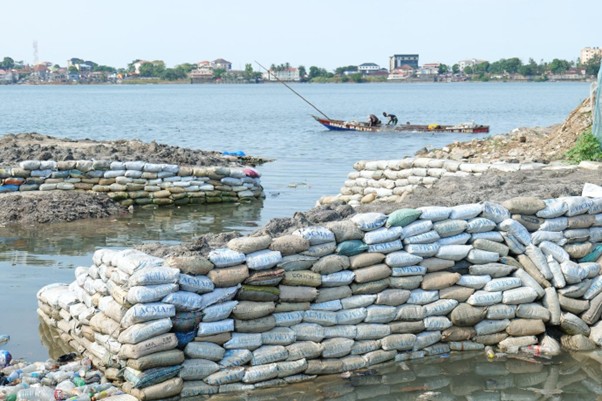
An artisanal sand miner and a petty trader with a family of seven, Sullay moved to Cockle Bay about a decade ago when he was evicted from a more expensive rental formal residential area of the city. “Some wealthy people bought the property, and the rent became expensive. I couldn’t afford it,” he explained. Now a property owner, Sullay, has built his own house, happily living with his family without the burden of rent. He sometimes sells charcoal and mangoes to supplement his regular sand mining activity to diversify his income. He appreciates his new found home because living expenses and commodities are affordable. “I don’t struggle to secure my daily meals here. I can purchase fish, palm oil at a lower price… and with a daily income of Nle 100 ($ 4) to Nle 200 ($ 8).”
“When we first came here a decade ago, there were mangroves in certain areas, and the fish shelter and lay their eggs among them,” he recalls. “Now, most have been cleared,” Sullay went on. He could remember Aberdeen as a landscape of swamps and lush mangroves, now largely gone.
Aberdeen Creek is not the only example of environmental degradation he has witnessed in Freetown. He also points to Sugarloaf Mountain, overlooking the Creek. “In the past, Sugarloaf was covered with vegetation, but all that has been cleared to make way for construction,” he says. The foot of the mountain was the site of the deadly mudslides in 2017 that claimed over a thousand lives. The surroundings of Sugar Loaf Mountain are now dotted with high-rise buildings, including the U.S. Embassy, the European Union delegation, and the International Military Assistance and Training Team (IMATT) headquarters.
For Sullay, climate change is visible in these losses. He explains that Sugarloaf’s natural vegetation once regulated the rainy season, while the mangrove swamps of Aberdeen absorbed floodwaters and nurtured marine life are vanishing. “Before, even when the sun was high, you’d feel a cool breeze around IMAT. We don’t experience that anymore,” he says. “Freetown had many more trees. You could look toward the hills and see thick forests. I believe cutting down of trees is why the rains are no longer steady, and why animals have disappeared from those areas.”
He and his family now face extreme weather events (EWEs): intensifying heat, stronger winds, unpredictable and heavier rains, sea-level rise, and flash floods that invade their home. “In the dry season, our houses get extremely warm, and it’s really affecting us,” Sullay notes. “This excessive heat started in 2024.”
At night, he and his children could not sleep “peacefully” in the corrugated zinc house (pan body) as a result of the heat trapped in the building. To cope with the heat, he would either use an electric fan if there is electricity or leave the door open, but these solutions bring their own risks. “I have had a situation wherein I left my door open during the night, for us to feel some fresh air, only for me to wake up and find a thief trying to break into the house. The next day, the same thing happened, and they stole from me this time round, he shares. He also explained that while using a fan helps reduce heat trapped in the house, it sometimes leads family members to catch colds.
Sullay connects the climate change exacerbation directly to deforestation at Sugarloaf and the loss of mangroves at Aberdeen. “Many of the trees that provided shade and protection from storms are gone. That’s why the wind now destroys homes,” he says. “In the rainy season, heavy rain floods our house. Sometimes the wind is fierce even without heavy rain, and roofs are blown away.” Homes in the informal settlement are built close together, with little airflow, amplifying the heat.
Rapid urbanization and migration have placed enormous pressure on the remaining mangroves, which are vanishing as land is reclaimed for housing. “Twenty-five years ago, I never thought people could live along the Aberdeen waterfront,” Sullay reflects. “Now I’m one of them. In Freetown, everyone wants to build a house. That’s what’s causing this change.”
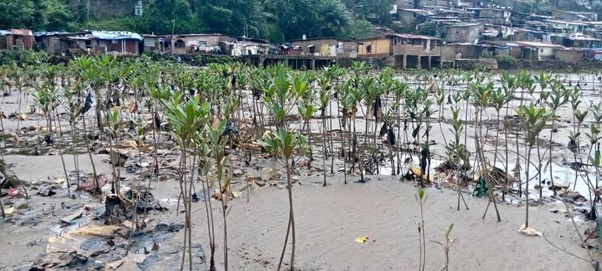
Sierra Leone is a signatory to the Ramsar Convention on the protection of wetlands. The protocol was signed in December 1999 and entered into force on 13th April 2000. In Sierra Leone, the Aberdeen Creek is designated as a wetland of international importance because it rich in biodiversity, and it is one of the national protected sites under the Ramsar Convention. However, restoration efforts have faced challenges[3]. On 2 February 2017, the Environmental Protection Agency, Sierra Leone, reported on their Facebook page of an effort in replanting mangroves across 250 acres and removing overhanging latrines, with a mounting community sensitization[4]. Freetown Mayor, Yvonne Aki-Sawyerr OBE, is leading “Freetown The TreeTown” campaign, a flagship climate adaptation and mitigation initiatives aim at planting five million trees by 2030 to restore, reduce flood risk, improve air quality, and carbon capture[5]. This initiative reported 60,000 mangrove restorations in 2021 to protect coastlines, reduce flooding, restore biodiversity, and create jobs by involving youth, women, and community volunteers[6]
Sullay has been a volunteer for the “Freetown the TreeTown” initiative. However, he feels the programmes are struggling to make an impact because they often follow top-down approaches, driven by government and partners rather than the community. He believes that a community-driven approach could help restore the Creek. Eager to see success, he has developed an interest in replanting and maintains a nursery for mangrove saplings close to his compound. “I have nursed mangrove seedlings that I would like to plant…if you like I will take you to see them”, he says. Sullay is optimistic that planting trees like mangroves provides shade and reduces the speed of strong winds that damage their homes. “By doing this, our community would benefit a lot from the trees...we will notice changes in the weather”. In addition to mangroves, he has started planting trees in his compound. Even though he knows it takes time for the trees to grow, “It is worth the wait”, he exclaimed.
He is calling for additional support from the community to drive his initiative forward. “We can achieve it… if we are many and united”, he says. “We couldn’t achieve it if we are not united”, he added, acknowledging that some community members are resistant to change.
Sullay is delighted that he is motivating some community members including the chairman, to get involved. “We have engaged the current chairman and told him that we want replant mangroves for the benefit of the community. The community authorities have developed an interest in it”, he says. “They are now assisting us to transplant the mangroves to the wetland”, he continued.
His request is simple: resources to plant trees. “We need money and farming tools. Some of us already have the skills—I’ve volunteered planting mangroves before. If we plant them here, we’ll notice changes in the weather. We’ll have shade in the dry season, protection from wind, and a healthier community. I’ve started planting in front of my house already. It will take time, but it will be worth it.”
“It will take time, but it will be worth it.”
— Sullay