"I was born and raised in this community. I also married and raised my children here, although the living conditions have been uneasy for us." Bintu is sitting on her veranda, reflecting on the challenges that she and her family face living where they do, and the changes she has witnessed. Moyiba, where she lives, is a dramatic place: it is a settlement perched on the hills of eastern Freetown. It was founded in 1919 as a farming community1. Although it is only 4.6km to downtown Freetown, back then, the lush vegetation and steep slopes would have felt a world away from the city's colonial streets and wooden Krio2 houses.
But in 1966 a stone quarry was constructed to provide the raw materials for major infrastructure projects in Freetown. With the opening of the quarry the settlement grew, and stone mining became a major livelihood activity. The quarry operated until 2002, when it was shut down at the end of Sierra Leone's decade long civil war. Now if you climb to the top of the hill in Moyiba you will find a huge water-filled crater remaining of the old quarry, surrounded by towering rocks, from where you can look down the hills to central Freetown and spot the major landmarks built with stone from the quarry: Queen Elizabeth Quay, Congo Cross Bridge, the National Stadium and the Youyi Building which houses government departments. Now buildings run uninterrupted from Moyiba's hills to these central landmarks. The contemporary settlement is home to 18,000 people and although the quarry has shut, informal mining continues to provide income for many of these residents. As the community has expanded, they have pushed further into the hills, the trees, the rocks, and the soil.
Bintu's life is part of this history, and she is telling us about how the environment has changed dramatically since her childhood. What was once thick forest, is now full of homes constructed on steep slopes and in between boulders, exposed to heat, erosion, and the unpredictable impacts of rain. She remembers vividly how things were:
"We were farming in the lower parts of the community, while the hillside was the area we used to fetch firewood, as it was forested. There was no house there, and no one wanted to live there. We did not dream of building homes in this part of the community."
Back then, the trees, soil and rocks held firm, and there was no reason to fear the water. Today, deforestation and stone mining have stripped away those protections. "Now, the hillside is bare, and when it rains, the mudslides come."
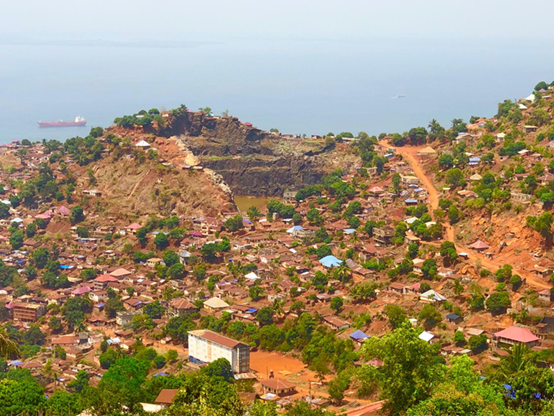
Moyiba Community
Photo credit: Abu Conteh
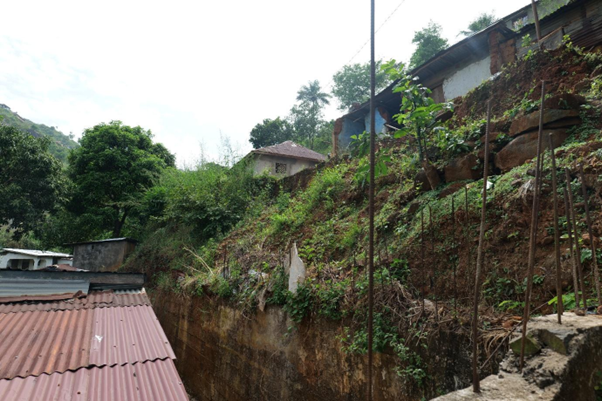
A steep slope at the back of Bintu's house
Photo credit: Ishmail Conteh
Two years ago, a mudslide collapsed the back of her house. "We were inside the house when it occurred; it was a rock that first rolled down on the backyard. We noticed it earlier and moved to the parlour before the mud fell on the house but were lucky that there was no fatality." Since then, every rainfall brings fear.
"I am always stressed and become sleepless when it rains, as my children's room is at the back of the house."
Her health and the environment compound each other and make these fears harder to bear. The heat can be oppressive, "I find it difficult to sleep when the place is hot; I did not sleep last night until dawn due to the heat." She has asthma and says that the heat worsens her breathing, and the rain triggers old trauma. "Whenever I hear a sound like something is falling, I get the shock and eventually experience an asthma attack because I feel like a stone is falling or a mudslide."
When asked about climate change Bintu doesn't immediately consider herself knowledgeable, although she experiences it in her daily life: "You will hear those who went to school say, it is because of climate change, but some of us don't know the actual way to call the situation". Bintu did not go to school, she says her parents had just moved from the provinces and did not have an understanding of education and that her mother needed her to help look after her younger siblings, "Sometimes, I feel angry with her because it is shameful to be born and raised in a big town like this, and not going to school". She was married at 14, which is common for many women from homes with strong traditional values, interacting with poverty in Sierra Leone.
Although Bintu feels she lacks the "right words" to explain climate change, she lives it as an everyday reality. It is the rain that floods her veranda, the wind that rattles her zinc roof, and the heat that suffocates her at night. Her life, and the minimal opportunities she has had, are also reflected in how she understands climate change, that is, as an economic constraint: "Recently, my children asked me what I understood about climate change, and I told them that the continuous rainfall is preventing us from going out to hustle. I asked them if that is not change, and one of them replied that it is."
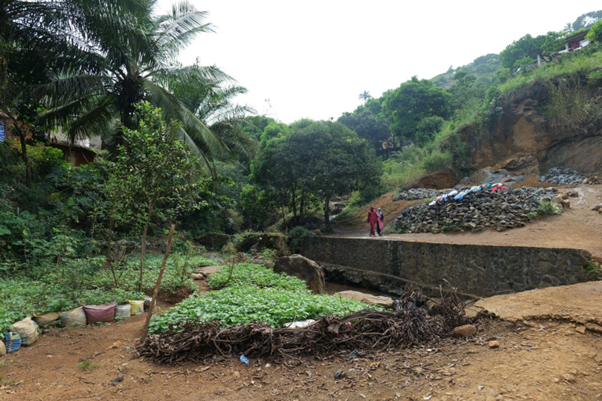
An area where Bintu mines stones and does gardening
Photo credit: Fasalie Kamara
Bintu's definition of health is also strikingly different from biomedical explanations. Her definition aligns with people's daily experiences that shape their health outcomes, including disruptions that impact their ability to make a living. "What does being healthy mean to you?" we asked. Her answer was simple: "It means that I am able to work. For example, this morning I went to the garden and plucked some leaves for my children to sell." Then she added, "Being unhealthy means being broke, because being broke is like a sickness."
Her framing of sickness mirrors the Krio phrase "welbodi na gentri" – health is wealth relates to social understandings beyond biomedicine.
She explains why: "You experience sickness when you are broke. For example, if my family and I wake up in the morning and have nothing to eat, it feels like a sickness. I believe that if I have money, I can provide food for them. I always feel sick when I am broke." Climate change makes this "sickness" worse. "The continuous rainfall keeps us at home and stops business. If the rain continues like this, it will be bad for us."
Her asthma attacks intensify during heat waves. "At night, the place becomes warmer when the doors and windows are closed, and it seriously affects my ability to breathe. Sometimes, when I walk down the hill, it is difficult for me to climb it, except that I call one of my children to bring me my medicine and assist me." She uses tablets now, after years of relying on herbal remedies, but the cost of formal healthcare is crushing. "You cannot go to the hospital without money. The first thing they ask for when you arrive is money." In Moyiba there are few roads, and many parts of the community are accessible only by foot, often across small bridges or step tracks. The terrain means basic services have not been established, including health centres. For those living in the upper part of the community getting to a hospital requires incredible costs and effort. Livelihood and health are tightly bound in her world. She mines stones and tends a small garden to keep her children in school. "I always tell them that I am still engaged in stone mining for their sake, regardless of my health condition. I would have stopped doing this work, but I have no alternative work to do, and their father is not working; I am the one taking care of them." The work worsens her asthma and leaves her in pain. She is pushing herself to the limit to give her children the opportunities she did not have.
Her coping strategies are practical but fragile: the use of plastic sheets to block rainwater, and a carpet to reduce cold from the tiles. She is also constructing a retaining wall at the back of her house to protect it from the impact of mudslides. The wall is being built slowly, whenever she can afford to add to it from her meagre income from stone mining: "We buy a few bags of cement, mould the bricks, and continue from where we stopped." What she needs most is help with her ongoing preventative work: "I want them to support us before disasters happen, not after. Personally, I need support with cement, sand, and iron rods to extend the retaining wall, and zinc roofing sheets to prevent leakages in my children's rooms."
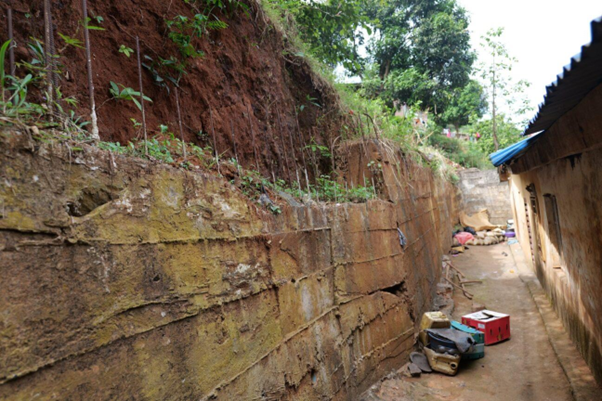
A retaining wall under construction at the back of Bintu's house
Photo credit: Ishmail Conteh
"Every day I have to worry about this place. If God has destined that this is where I will die, then so be it—but I am tired."
Koroma, B., Rigon, A., Walker, J., & Sellu, S. A. (2018). Urban livelihoods in Freetown's informal settlements.
Krio: Descendants of freed slaves from the Americas (e.g., Nova Scotians, Jamaican Maroons), Britain, and Liberated Africans resettled in Freetown from the late 18th to mid-19th century.