Mpilo started working at the Lerotholi food garden in 2020, during COVID. He joined his mother, Mam T, who had grown vegetables in the garden since the 1980s, when it was a Red Cross NGO project. There isn’t a day Mam T does not go to Lerotholi, and while slow because of her age, every morning she makes her way down the ten metre rows of spinach or onions bending and weeding.
I had recently started work in Langa, exploring climate change and its impacts on health in Cape Town’s vulnerable urban settlements. My time shadowing Mpilo happened to be in the weeks leading up to my grandmother’s passing; she was in the ICU at a hospital in Johannesburg, and themes of illness and death contoured our conversations. Mpilo told me that these days in Langa, it is as though every weekend there is another funeral. On two occasions, he had to leave the garden early to pay his respects to a family in grief.
“I will be honest with you: there is this disease called high blood. It’s causing havoc. Diabetes, too; people now don’t have legs here.” — Mpilo
Mam T has high blood pressure, but Mpilo affirms that she is healed by the garden and the meals it provides her. The same cannot be said for the majority of Langa’s residents, who bear the brunt of a country-wide food crisis and the associated health “havoc” described by Mpilo. A ‘hushed havoc’ (drawing from Nixon’s writing on slow violence), invisibilised and attritional.
In macro terms, South Africa is one of the most food-secure countries on the continent. Each year, we produce more food than is needed to meet the nutritional needs of our whole population. And yet, 63.5% of South Africans are food insecure, an alarming statistic that emerged from the National Food and Nutrition Security Survey of 2024. This seeming contradiction attests to the systemic inequality of our food system. Food insecurity is a real threat to the country’s poor, Black majority. Exacerbated by the COVID pandemic, more and more households are reliant on meagre social grants to put food on the table.
The City of Cape Town has the highest hunger levels amongst other major South African metropoles. Most of the city’s residents rely on supermarket-bought food and thus primarily on 5 mega-retailers who alone profit from over half of food retail sales in Southern Africa.
Lack of access to nutritious food is a major risk factor for non-communicable diseases (NCDs), and for South Africa’s majority, the risk of starvation or slow death by chronic illness is an everyday risk. It is also women-headed households who are more likely to be food insecure, and women experience higher rates of chronic illness, the most prevalent being high blood pressure and diabetes, both of which are largely determined by access to a nutritious diet.
High blood pressure and diabetes are framed as “lifestyle issues”, and yet all 15 of the people I spoke to in Langa raised NCDs as the dominant health concern in their neighbourhood, in response to which, besides taking pills prescribed at the Vanguard clinic, there is nothing else they can do.
For Langa’s residents, as for most people in South Africa, high blood pressure, diabetes or even stomach ulcers can be a terminal diagnosis. The prescribed responses “eat less fat”, “cook fresh food”, “manage stress”, and “don’t take medication on an empty stomach” are absurdities in a context of rampant unemployment and soaring food and electricity prices.
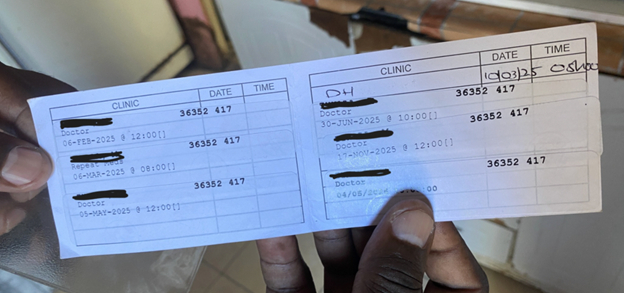 Photo: Author, March 2026
An appointment card listing repeat check-ups for high blood pressure. Joe Slovo, Cape Town.
Thus, health outcomes in Cape Town’s vulnerable urban settlements cannot be understood without engaging the crisis of food insecurity.
This is the context in which climate change lands in Langa. It’s impacts not necessarily the sensational images of disaster, but an amplification of health hazard that is slow moving. Residents experience the ‘climate hazards’ we asked about in our interviews through their chronic illness, exacerbated by hunger.1
Nozibele had skipped a meal to save money. It was going to be a hot day, January in Cape Town. She didn’t take her pills before getting up for work at 4 am. And so, she remembers that day
[steamy train, long lines of tickets to check, searing migraine and throbbing vision]
as one of the days high bp almost killed her.
In winter, Dumi lies in agony at night, freezing, arthritic and unable to sleep. The doctors tell her she must lose weight to ease the pain in her knees.
“I must eat healthy, also for my sugar levels. I must diet. How am I supposed to diet when I am not even working?”
Nomkhitha and ZK, whose blood pressure soars from the stress of sweeping water when it floods, also suffer from stomach ulcers.
“When I am not working, I can’t say I mustn’t eat this, that I must eat chicken fat. I must eat because I am hungry.”
Nomkhitha“Yeah, … we are not working…”
ZK“Then you are sick, you have no choice when you are not working.”
Nomkhitha“Because you are hungry…”
ZK“When you are hungry, you must eat everything…”
Nomkhitha“But I’m hungry. ‘Don’t eat spice, don’t eat tomatoes, oranges’, acid.”
ZK“‘Don’t eat fish oil too much, don’t eat this and that’, but we have to eat, we have no choice.”
Nomkhitha“If you give me rice with spice, I’m going to eat it because I’m hungry. Ulcers start…”
ZK“We don’t have veg, you must take your rice and put spice. No meat, nothing, spice…”
Nomkhitha“And fatty foods.”
ZKRelying on a small urban food garden for one’s health and life is simply not a viable option for most people in Langa. Even for Mam T, her source of coping and healing via the garden is increasingly circumscribed. Mpilo is feeling the change in his garden; his spinach grows less frequently, he says it now grows yellow. Nozibele, Nomkhitha, Dumi, and ZK are feeling it through joint pain, dizzying headaches, heartburn, and fatigue.
Hazard and hunger converge on the body through chronic illness, and in Langa, climate impacts are rarely a rupture, but a seeping and deepening of slow death in the settlement.
1 The material link between chronic illness and food insecurity will also only be intensified as climate change accelerates, as it poses a major threat to food production, distribution, and access in South Africa.